


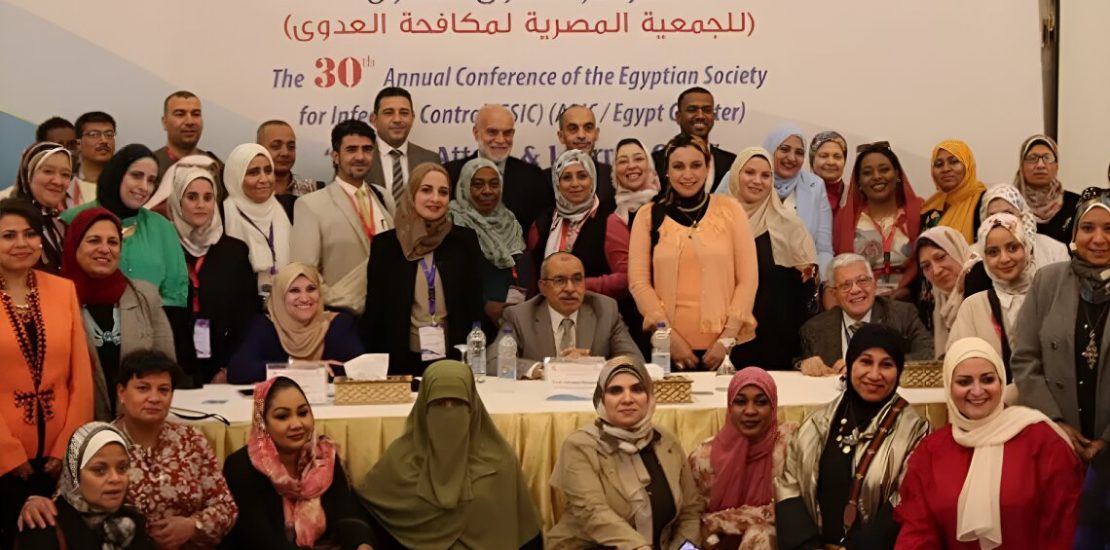
Under the sponsorship of the Arab Doctors Union and the World Health Organization office in the Arab Republic of Egypt, the Egyptian Society for Infection Control held the thirtieth annual conference over three days from the third to the fifth of November 2022. The conference this year was entitled: “Train 2 Attain & Learn 2 Gain”.
A group of scientists specialized in the field of infection prevention and control, patient safety and biosecurity at the local, regional and global levels participated in the conference.
The conference witnessed a large attendance, with more than 300 people interested in preventing infection control and providing safe health care.
The conference activities included an opening session chaired by Professor Dr. Osama Raslan, Secretary of the Arab Doctors Union, in which Dr. Salim Abi Saleh, Chairman of the Supreme Council of the Arab Doctors Union, and Dr. Liz Taylor, on behalf of Dr. Naima Al-Qaseer, Director of the World Health Organization Office in the Arab Republic of Egypt, and His Royal Highness Prince Abdul Rahman bin Mishal bin Abdulaziz Al Saud.
The scientific program began with the opening lecture, which bore the same title as the conference – in which Professor Dr. Osama Raslan spoke about the importance of training and learning as the basic pillar of health professional development.
The scientific program began with the opening lecture, which bore the same title as the conference – in which Professor Dr. Osama Raslan spoke about the importance of training and learning as the basic pillar of health professional development.
The scientific program included five sessions, a panel discussion, and two workshops.
The conference discussed a number of topics, the most prominent of which were effective training, modern and innovative learning methods, their role in professional development, eradicating health literacy among patients, their role in maintaining public health, microbial resistance to antibiotics, and the efforts made by the Arab Republic of Egypt in cooperation with the World Health Organization in combating For this problem, modern technology and the modern innovations it offers serve the field of infection prevention and control and the challenges associated with its use, An economic study that presented evidence of what adherence to infection control policies can provide in saving the direct and indirect costs of health care, raising awareness of the role of the human papilloma virus in causing some cancerous tumors, especially cervical cancer in women, and the importance of vaccination. To prevent infection and reduce the spread of these tumors.
The conference also discussed biosafety and a course in protecting society from the spread of epidemics and pandemics, with the presentation of international models from the College of Public Health at the University of Nebraska in the United States and the North African Infection Control Centers Initiative in this field, the monkeypox virus, the various methods of diagnosis, prevention of infection and treatment, various chemical disinfectants and their role. In preventing the transmission of infection and the necessity of following rational policies in their use based on scientific evidence to avoid the emergence of microbial resistance and loss of their effectiveness, and the problem of reusing “single-use” medical tools imposed by economic conditions, the challenges and risks that accompany their repeated use, and the professional, ethical and legal principles that govern their use.
The conference also touched on the importance of integration between various health care specialties to provide safe health care and prevent surgical infections, and the importance of combating the spread of rumours, especially when infectious diseases and epidemics appear and spread. The impact of climate change on the spread of infectious diseases and the spread of epidemics, and the role of the Arab Authority for Accreditation of Professional Programs affiliated with the Arab Doctors Union in ensuring the quality of learning and training in various fields of health care in the Arab region.
The conference concluded with some recommendations, the most prominent of which were:
1. Train… Learn… Reap… The need to pay attention to effective training and modern and innovative learning methods, especially distance learning, as it is the basic foundation for professional development for all health care workers.
2. Ensure that all professional development programs in the field of health care are accredited by reliable and recognized scientific bodies to ensure the quality of the training and learning process.
3. Ensure that training courses on basic skills to prevent and control infection are among the licensing requirements for all health care workers.
4. The necessity of working on the presence of “integrated professional teams” and raising their efficiency as they are the guarantor of providing safe comprehensive health care.
5. The necessity of paying attention and expanding studies on the economics of health care, especially with the economic problems facing society.
6. The necessity of forming an independent scientific entity or body that includes all the necessary scientific expertise from various professional specializations to review laws and regulations and develop integrated programs to confront the challenges facing our Arab and African regions, most notably training on and activating integrated systems for health and biosecurity and benefiting from the expertise available at the global and regional levels.
7. The necessity of forming a committee of experts that includes the various specializations related to the use of medical tools, such as doctors who use these tools and those working in the field of infection prevention, patient safety, risk management, medical engineering, health care quality, hospital management, and legal experts, to review the scientific and legal evidence related to the reuse of “single-use” medical tools so that they are Able to make sound decisions based on scientific evidence and develop a national policy that primarily ensures the safety of patients and health care workers.
8. The necessity of transferring technology for producing various types of disinfectants, as well as manufacturing medical tools according to international standards, such as personal condoms and sterilization materials and reagents, so that entities capable of providing these basic needs for safe health care are available in our Arab region, especially in light of the world’s suffering from difficult economic conditions imposed by wars and climate change. The outbreak of epidemics has hindered import and export operations.
9. The Egyptian Society for Infection Prevention and Control, represented by its Board of Directors and working members, declares its full readiness to cooperate, exchange experiences, and provide scientific advice to all parties and bodies to ensure the provision of safe health care.
10. The necessity of raising awareness of the dangers of climate change and the importance of raising awareness about keeping the environment safe and healthy.
11. Praise for the climate conference that will be held in Sharm El Sheikh in the coming days because of the direct and indirect impact climate change has on the health of society.