


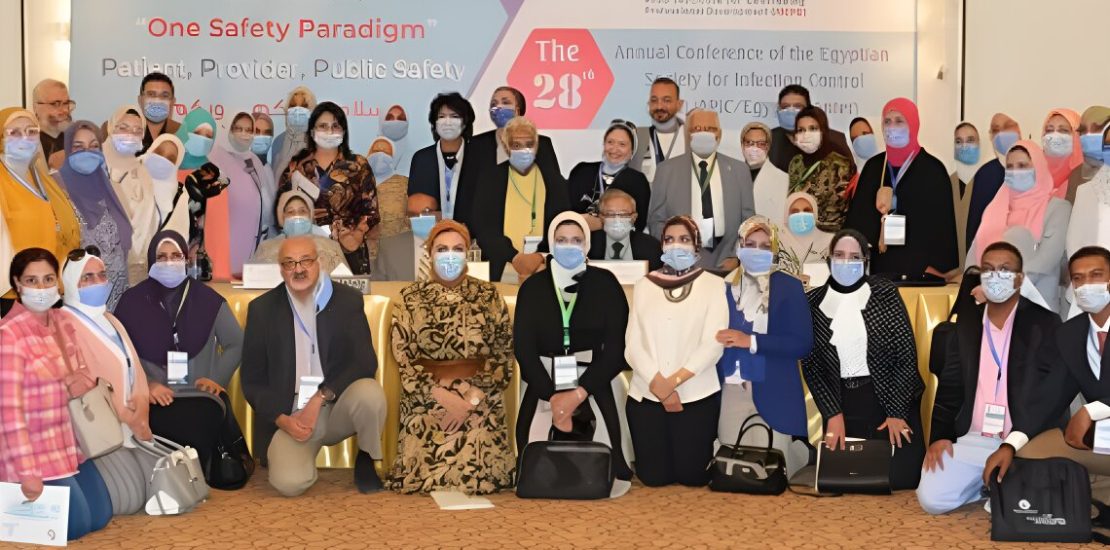
The day before yesterday, the activities of the 28th annual scientific conference, organized by the Egyptian Society for Infection Control in cooperation with the Arab Institute for Sustainable Professional Development and the Arab Patient Safety Association, and under the auspices of the Arab Doctors Union and in scientific partnership with the World Health Organization, concluded over three consecutive days at the Tulip Hotel on the North Coast.
During five scientific sessions and two workshops, the conference discussed the most important scientific developments regarding patient safety, health worker safety, and environmental and community safety in light of the global coronavirus pandemic.
The conference was attended by more than two hundred people interested in the field of infection prevention and control and patient safety, including faculty members at various Egyptian universities, doctors, pharmacists, dentists, nurses, workers in medical microbiology laboratories, and health facility management.
The scientific activities of the conference began with an opening lecture delivered by the conference president, Prof. Dr. Osama Raslan, Secretary General of the Arab Medical Union, in which he discussed the development of the concept of safety and how to change concepts related to safety in health care and the keenness to change traditional patterns in health care practices, each in its place in light of intellectual developments. Preparatory, administrative, educational, training and environmental, with emphasis on the importance of continuous innovation and development based on existing basics and in order to benefit from developments in the era of information technology and the stage of development of perception and mental awareness, in order to achieve true safety for all.
Dr. Munther Latif, Regional Advisor to the World Health Organization, participated in an intervention on the safety of patients and health workers in the Eastern Mediterranean region
Professor Dr. Maha Fathi, Professor of Medical Microbiology and Immunology at Ain Shams Medicine and Secretary General of the Egyptian Society for Infection Control, discussed the reopening of health care services for dental patients and knowledge of the developments, requirements and procedures that must be available for the safety of workers and patients alike.
Then discussions and scientific sessions continued, and the conference ended with a number of recommendations, which were as follows:
1. The necessity of raising community awareness and changing concepts to achieve the principle of safety first and for all groups, and the necessity of working to eradicate health literacy to ensure good communication when providing health care services, combating rumors and lies, and correcting misconceptions regarding vaccines and resistance to infectious diseases.
2. Adopting good health practices based on wise scientific rules is the alternative until scientific evidence is available.
3. Determining what data should be collected, analyzed, and publishing the results of its analysis in health care facilities to achieve patient safety must take priority over the amount and volume of data collected.
4. Integrating the patient safety course into the various health educational programs for the bachelor’s level and various postgraduate and professional development programs.
5. Encouraging the reopening of health services to care for dental patients, as well as the opening of schools and various community activities, provided that all measures are taken to ensure the implementation of safety procedures.
6. Investing in all efforts currently being made to confront the pandemic and improving the services provided in health care facilities as well as various community institutions such as schools and others, building on them and taking all guarantees for continuity and sustainability.
7. Establishing local controls, guided by their global counterparts, to ensure the application of standards for the manufacture, import, distribution, and use of personal protective equipment to achieve the safety of health workers and patients.
8. Rationalizing the use of disinfectants and chemicals in health facilities and in society and relying on scientific rules and good practices for the safety of individuals and the environment.
9. Raising the efficiency of medical microbiology laboratories, implementing biological risk management programs in them, and having them approved by responsible bodies in order to provide safe health care, limit the spread of epidemics, prevent biological risks, and ensure environmental safety.
10. Raising the efficiency of engineering departments in health facilities and integrating their specialized officials into infection control, health quality, occupational safety and health committees and other relevant committees to ensure the safety of the work environment and the provision of safe health care.
11. The importance of having a model to determine the extent of health institutions’ readiness to deal with the pandemic and other disasters and emergency matters, in addition to applying the risk management matrix, in order to achieve a proactive strategy in dealing with the risks and threats facing health systems. Each institution must design these models in a way that suits its circumstances in order to facilitate their work and use by employees and to remove the obstacles that prevent their implementation.
12. The necessity of integration between the various specializations in the health facility, including management, infection prevention and control, quality of health services, risk management, and patient safety, to work as one harmonious team, especially during the spread of epidemics and infectious diseases, to ensure achieving the principle of safety first.